Case study 02 / Conversation and AI debate prototype
Agora
Room for another point of view.
A discussion and debate prototype with structured practice rounds, local conversation state and a separate experimental AI debate engine.
- DiscussTopics and replies
- ChallengeInvitation and terms
- DebateThree rounds
- ReviewTranscript and scope
An identity built around opposing perspectives.
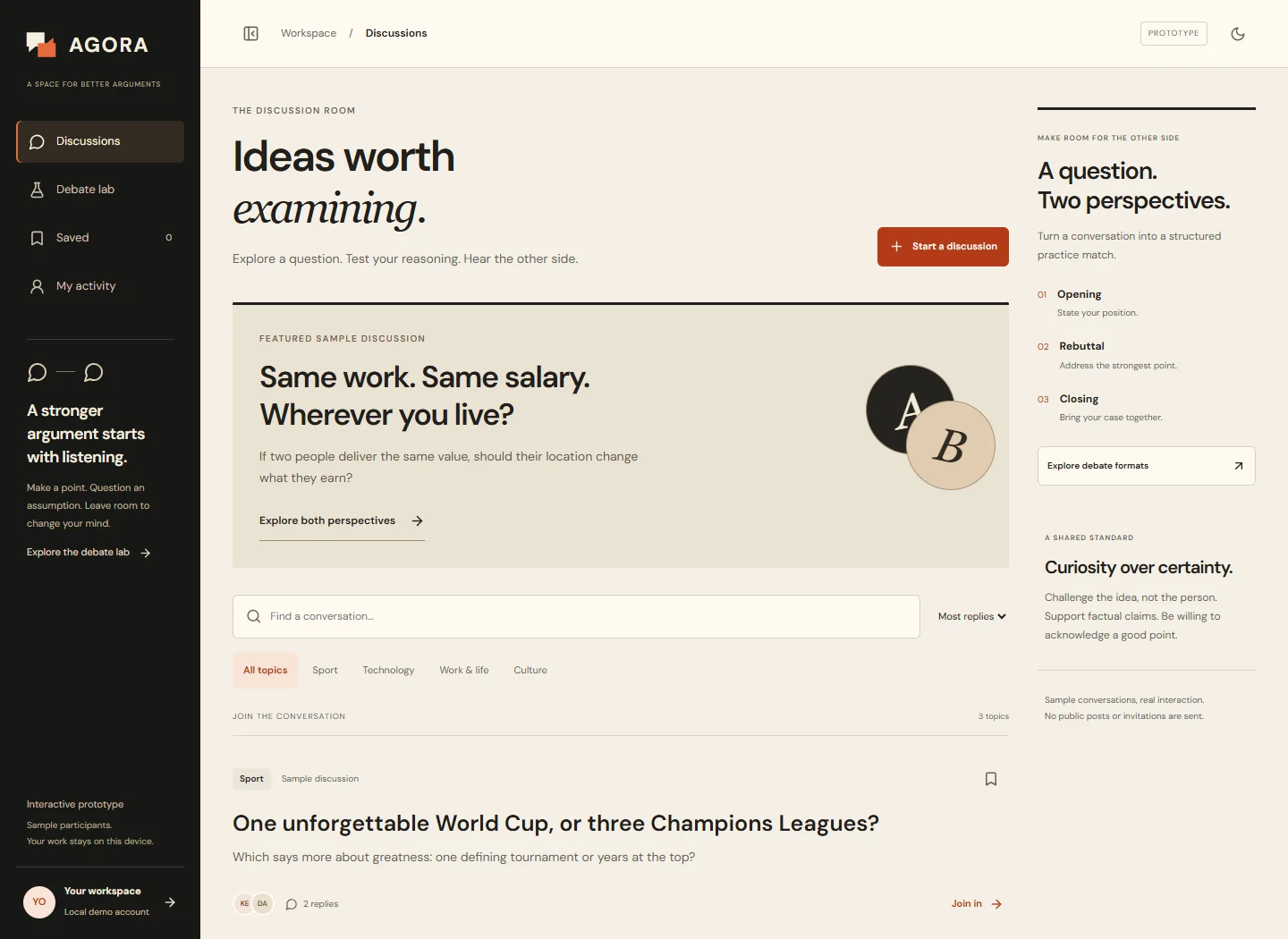
The redesigned workspace uses cream, ink and restrained burnt-orange actions. Interlocking speech shapes form the Agora mark. Editorial headings, a featured discussion and a quieter topic list give the conversation a clear hierarchy.
Mobile navigation, a persistent light/dark preference and a separate debate setup area support the same discussion, saved-topic and three-round practice flows. The public preview embeds its assets and disables live AI connections.
Start with a conversation, not a scoreboard.
Agora puts topics and replies first. A participant can challenge a sample contributor, preview acceptance, and move through opening, rebuttal and closing statements.
The browser-only demo uses labeled scripted responses. It provides a complete interaction without implying real users, multiplayer, money or an AI-generated verdict.
Keep interface state and model execution separate.
React renders discussions and match views. A typed reducer handles local state; stored data is validated on load. A separate Node.js module runs the experimental AI lab through Vite development middleware.
The lab makes separate argument calls for each side and a separate judge call. Both sides see the same completed-round context. Model identities are withheld from the judge input.
Failure is a state, not an invented result.
Duplicate starts reuse a run, concurrent runs are rejected and cancellation retains the partial transcript. Provider failures stop execution without inserting fabricated turns or automatically retrying paid calls.
Judgments validate score ranges and turn references. Optional evidence checks only admit retrieved source URLs; unsupported citations are downgraded to uncertain. These safeguards do not establish that a model judgment is factually correct.
Test the debate rules without paid inference.
Twelve tests passed in the reviewed local snapshot. They cover match acceptance, duplicate submissions, cancelled invitations, prediction locking, malformed storage, balanced round context, provider failure, cancellation and judge validation.
Provider responses are mocked in these tests. No live model call, model-quality benchmark or hosted multiplayer capability is claimed.
A local experiment with a clear next step.
The public practice demo stores data only in the visitor’s browser. The AI engine keeps runs in process memory and is wired to a local development server.
Production work would need authenticated users, durable server state, rate limits, an operational cost boundary and independent evaluation of the judging process. The source evidence links to the reviewed revision in Agora’s own GitHub repository.
Source reviewed at revision ceb3eb1. View the reviewed snapshot.